BDL Tegna

The Estate
All that remains of the original rustic structures is the exterior shell. Inside is a single open space on two levels, where the living area and sleeping area are separated by a wooden monolith that encloses the bathroom. Architect Matteo Inches designed the project and oversaw the construction, which lasted nearly three years.
The Origins
BDL - Benefattori di Livorno
Between the late nineteenth and early twentieth centuries, people set out from these lands in search of a better future. They left hunger and scarce work behind and set sail for Australia, California, France, or Italy, chasing the promise of a different tomorrow. Our family, too, followed that flow. In Livorno, a port that opened up to the world, a large group of people from Tegna found a new home. And, though far away, they never forgot their homeland: they funded public works and votive offerings in Tegna, signing each contribution with three simple letters—BDL, Benefattori Di Livorno—so that the memory would not be lost.
Stories from Around the World
Every object in this house tells a story of a corner of the world. The wooden benches evoke the rural life of France, while the cast-iron counter tells the story of English industrialization. On the low table in front of the sofa, tuna was once cut up in Japan during the 1920s. The old amphora still echoes with the scents of oils and wines from 19th-century Turkey. The dining table, with its three stools, has shared simple meals in a rural Chinese home; small glass jars have held spices, remedies, and hopes. A desert headrest and water jugs tell of a distant Africa. A Sicilian majolica piece, a Spanish ex-voto, a lavish French mirror next to a more humble one of unknown origin. The first letter sent home by one of our ancestors shortly after landing in California and the photograph of the ship that carried him away from here.
Every object is a story that makes no noise, yet endures.


The imprint and the circle
On the walls of the house, two of the most important contemporary artists—both born in Ticino—have interpreted the space. Niele Toroni has left her brushstrokes from No. 50, and Felice Varini has brought a circle from his memory here, adapting one of his earliest works, *Rue Pali-Kao No. 1* from 1981. Their works engage in a dialogue with those of the Scottish artist Callum Innes, with Paula’s photograph hanging above the bed of the Dutch artist Henrik Kerstens, while in the garden, an imposing work by Ulrich Rückriem blends in among the stones skillfully repositioned in the ancient art of dry-stone walling by our friend Markus, who is also, in our eyes, a great artist. On the patio, a sculpture by Didier Vermerein highlights the fundamentals of sculpture.
The Garden
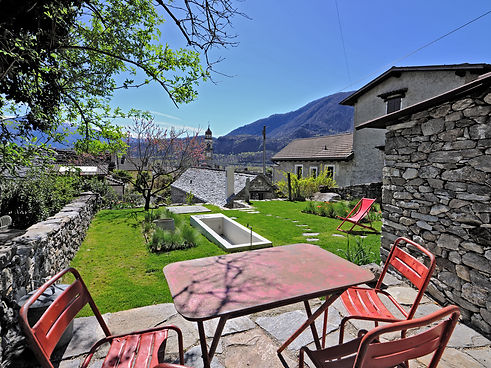
The spacious flower garden is surrounded by old dry-stone walls—a construction technique that is becoming increasingly rare. Ancient “carasc”—granite supports for rows of vines or pergolas—dot the perimeter. In the small pool, reminiscent of old farm troughs, you can take a refreshing dip and enjoy a quiet moment on hot summer days.

The Patio
Built from scratch with cobblestone paving reminiscent of Piazza Grande in Locarno, this space offers a shaded corner of the house where you can enjoy dinner or an aperitif in complete relaxation, surrounded by stone walls and flower beds.